
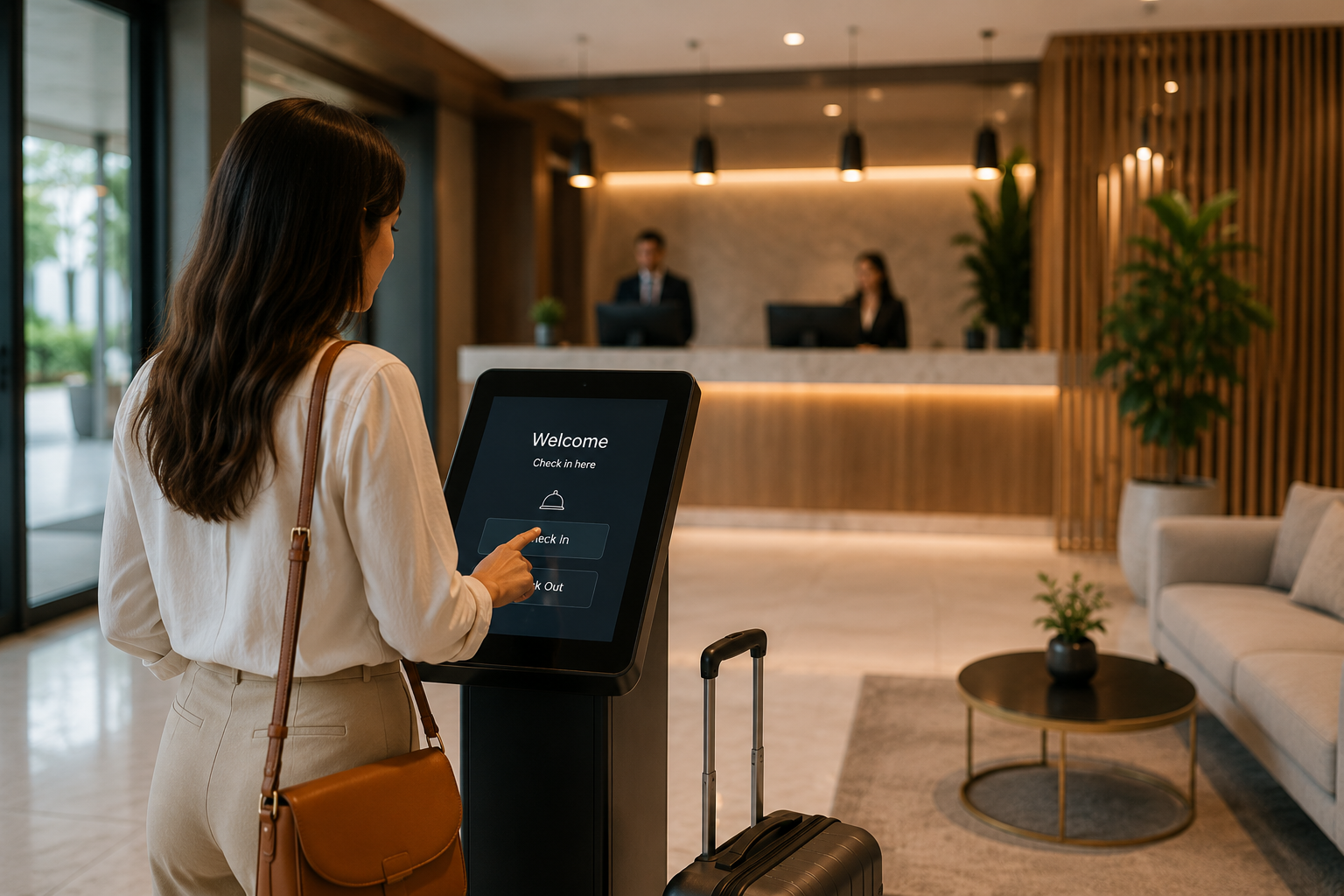
Running a hotel front desk has always required balancing two competing priorities: delivering great guest service and controlling operating costs.
The problem is that guest demand does not follow a convenient staffing schedule.
Guests arrive late. Phones ring while employees are checking someone in. Travelers need help after midnight. A line can form in the lobby while the person at the desk is handling a reservation call, processing a payment, answering a routine question, or solving an issue for another guest.
That is why more hotel operators are evaluating the virtual hotel receptionist.
A virtual hotel receptionist allows hotels to move many traditional front desk responsibilities beyond a single employee standing behind a physical counter. Depending on the system, guests can connect with a remote receptionist, use a self-service kiosk, communicate digitally, or combine these options with an on-site team.
The objective is not necessarily to eliminate the hotel front desk.
It is to build a front desk operation that can serve guests 24 hours a day without requiring every interaction to be handled by an employee physically standing in the lobby.
What Is a Virtual Hotel Receptionist?
A virtual hotel receptionist is a remote or technology-enabled front desk solution that allows hotels to handle guest interactions without requiring the receptionist to be physically located at the property.
The receptionist may assist guests through:
- A hotel lobby kiosk
- Video or audio communication
- Phone calls
- Digital messaging
- Remote front desk software
- Automated or AI-supported guest communication
Some virtual receptionist solutions are primarily AI-based. Others use live remote hospitality agents. More advanced virtual front desk models combine technology, self-service, and human support.
For hotel operators, that distinction matters.
Hotels are not simply answering phones. The front desk sits at the center of the guest arrival experience and regularly deals with payments, identification, reservations, room access, property questions, complaints, and situations that require judgment.
The strongest virtual hotel receptionist model therefore does not automate everything. It determines which interactions can be handled remotely, which can become self-service, and when a human should step in.
How Does a Virtual Hotel Receptionist Work?
A virtual receptionist changes where and how front desk service is delivered.
Instead of requiring one employee to handle every guest interaction from behind the desk, hotels can distribute those responsibilities across technology and remote staff.
Consider a guest arriving late at night.
With a traditional front desk model, the hotel may need an employee physically present primarily because someone might arrive or need assistance.
With a virtual front desk, the guest can instead approach a kiosk, begin the check-in process, and connect with a live receptionist when assistance is required.
The remote receptionist can support the interaction while the technology handles parts of the process that do not require an employee to be standing at the property.
The same concept can extend beyond check-in.
A virtual hotel receptionist may help hotels manage:
Guest Check-In
Guests can begin or complete parts of the arrival process through a self-service kiosk while receiving remote assistance when necessary.
After-Hours Front Desk Coverage
Hotels can maintain access to front desk assistance even during periods when on-site staffing would otherwise be limited.
Guest Questions
Routine questions about check-in, checkout, property policies, amenities, parking, Wi-Fi, or other hotel information can be handled without pulling an on-site employee away from another guest.
Incoming Calls
Reservation inquiries and property calls can be routed away from the physical front desk so staff are not constantly switching between phone and in-person guests.
Front Office Assistance
Remote staff can help support administrative and guest-service functions that do not require someone to physically be at the property.
The result is a front desk that is less dependent on a single person being in one place at all times.
Why Hotels Are Considering Virtual Front Desks
For many hotel operators, the interest in virtual reception is less about technology and more about the economics of running a property.
A traditional front desk has a structural problem.
The hotel needs coverage based on availability, while employee productivity depends on actual workload.
There may be periods when the front desk is overwhelmed followed by hours when very little happens. Yet the property still needs someone available in case a guest arrives, calls, or needs assistance.
That creates several operational challenges.
1. Providing 24/7 Coverage Is Expensive
Maintaining three shifts of continuous front desk coverage can create a significant labor requirement, particularly for limited-service, select-service, independent, and extended-stay properties.
The challenge becomes even greater when accounting for scheduling gaps, overtime, turnover, training, call-outs, and management coverage.
A virtual hotel receptionist gives operators another way to design coverage instead of automatically solving every scheduling gap with another on-property shift.
2. Front Desk Employees Constantly Context-Switch
One employee may be expected to:
- Check in arriving guests
- Answer the telephone
- Handle reservation questions
- Process payments
- Respond to existing guests
- Coordinate with housekeeping
- Resolve complaints
- Provide directions
- Support late arrivals
Each responsibility may be straightforward individually.
The operational problem is that they frequently happen at the same time.
Moving appropriate tasks to a virtual front desk can allow the on-property team to focus on the interactions that actually require their presence.
3. Guests Increasingly Expect Self-Service
Hotels are competing with experiences guests encounter everywhere else.
Travelers can check into flights from their phones, use self-checkout at stores, manage banking without visiting a branch, and order transportation without speaking with a dispatcher.
Hotel guests increasingly expect the same flexibility.
That does not mean every guest wants a completely automated stay.
It means guests increasingly value the choice to complete a simple task quickly without waiting unnecessarily.
4. After-Hours Service Is Difficult to Staff Efficiently
Overnight coverage creates a particularly difficult tradeoff.
Demand may be low, but the consequences of having nobody available can be significant.
Virtual reception gives hotels a way to maintain guest support without designing the entire operation around the possibility of an occasional late-night interaction.
Virtual Hotel Receptionist vs. AI Hotel Receptionist
These terms are increasingly used interchangeably, but they are not necessarily the same thing.
An AI hotel receptionist typically uses artificial intelligence to answer calls, respond to questions, manage chats, or automate specific guest interactions.
A virtual hotel receptionist is a broader operating model.
It can include AI, but it may also include live remote receptionists, kiosks, communication tools, and hotel systems working together.
That difference becomes important when the interaction involves something more complicated than answering a question.
AI can be extremely effective for repetitive interactions such as:
- What time is checkout?
- Is breakfast included?
- Do you allow pets?
- Where can I park?
- What is the Wi-Fi password?
But hotel operations also involve exceptions.
A reservation may not appear correctly. A payment may fail. A guest may be upset. Identification may need to be reviewed. Someone may need to determine whether a situation should be escalated.
The better question for hotel operators is therefore not:
“Should our front desk be human or AI?”
It is:
“Which parts of our guest journey should be automated, which should be remote, and which should remain human?”
Virtual Hotel Receptionist vs. Traditional Front Desk
A virtual front desk does not need to be an all-or-nothing replacement for a traditional front desk.
For many properties, the strongest model will be hybrid.
Traditional Front DeskVirtual Hotel ReceptionistStaff must be physically presentReceptionist can support guests remotelyCoverage tied directly to staffingCoverage can be distributed across locations or teamsPhone and lobby demand compete for attentionCalls and guest interactions can be separatedGuests usually wait for an employeeSelf-service can handle simpler interactionsOvernight coverage requires on-site staffingRemote support can extend coverageCapacity limited by employees on propertyRemote teams and technology can expand capacity
The right model depends on the property.
A luxury resort providing highly personalized concierge service has different operating requirements than a limited-service roadside hotel.
The objective should be to redesign the operation around what guests actually need rather than adopting technology simply because it is available.
Which Hotels Benefit Most From a Virtual Receptionist?
Virtual reception can apply across hospitality, but the economics tend to be especially compelling for properties where front desk coverage represents a significant portion of operating labor.
That can include:
Limited-Service Hotels
Many guest interactions are transactional and predictable, making it easier to move appropriate workflows into self-service or remote support.
Select-Service Hotels
These properties still need strong guest service but often operate with leaner teams than full-service hotels.
Extended-Stay Hotels
Longer stays can mean fewer daily arrivals relative to room count, making continuous traditional front desk staffing less efficient during certain periods.
Independent Hotels
Independent operators may not have the staffing scale or shared services infrastructure available to large hotel groups.
Multi-Property Hotel Operators
Virtual front desk operations become particularly interesting when support can be shared across several properties instead of each location independently staffing every function.
That changes the economics from thinking about front desk staffing property by property to thinking about front office capacity across the portfolio.
What Should a Virtual Hotel Receptionist Be Able to Do?
Hotel operators evaluating virtual front desk technology should focus less on feature lists and more on workflows.
Start with the guest journey.
A useful virtual receptionist system should help address several questions.
Can Guests Actually Reach Someone When They Need Help?
24/7 availability means little if guests become trapped in an automated workflow when something goes wrong.
There should be a clear path to human assistance.
What Happens During Check-In?
Understand which parts of the arrival process can happen through the kiosk or remotely and which still require someone on property.
How Are Exceptions Handled?
The normal check-in is rarely the problem.
Ask what happens when:
- A reservation cannot be found
- A payment is declined
- A guest requests a room change
- Someone arrives earlier than expected
- The guest has a complaint
- The technology stops working
The exception workflow often matters more than the standard demo.
Can It Work With Your Existing Hotel Operation?
A virtual receptionist should fit into the property's broader technology and operational environment rather than creating another disconnected system employees have to manage.
What Work Actually Disappears From the Front Desk?
This is one of the most important questions.
Adding technology does not automatically create efficiency.
If employees still perform all the original tasks plus manage the new technology, the hotel has added complexity without removing work.
The goal should be measurable workload reduction.
Will Virtual Receptionists Replace Hotel Employees?
For most hotels, that is the wrong way to think about the opportunity.
Hospitality remains a people business.
The purpose of a virtual hotel receptionist should be to use employees where human interaction creates the most value.
A guest with a complicated issue may need empathy and judgment.
A guest who simply wants to check in at 11:30 p.m. may primarily want the process to be fast.
Treating those two interactions exactly the same is not necessarily better hospitality.
The opportunity is to remove repetitive work and unnecessary waiting so hotel teams can spend more time on the moments where people actually make a difference.
How Kiotel Approaches the Virtual Hotel Front Desk
Kiotel's approach combines the convenience of self-service technology with access to a live virtual receptionist.
Guests can interact through an on-property kiosk while the hotel maintains remote front desk support beyond the physical reception counter.
For operators, the objective is straightforward: provide dependable guest service while reducing the amount of front desk coverage that must be delivered entirely through on-site staffing.
This allows hotels to rethink the front desk as a service rather than simply a physical location.
Instead of asking:
“Who needs to be standing behind the desk?”
Operators can ask:
“What does the guest need right now, and what is the most efficient way to provide it?”
That is a fundamentally different way to design hotel operations.
The Future of the Hotel Front Desk Is Hybrid
The hotel front desk is unlikely to disappear.
But it is changing.
Over the next several years, more hotels will separate the idea of front desk service from the idea of an employee permanently standing behind a counter.
Routine transactions will increasingly become self-service.
Common questions will increasingly be automated.
Remote teams will support multiple functions and properties.
On-site employees will spend more of their time handling the interactions where physical presence, judgment, or hospitality matter most.
The winning model is unlikely to be completely automated or completely traditional.
It will be a combination of technology, remote support, and people working together.
For many operators, the virtual hotel receptionist is the first step toward that operating model.
Frequently Asked Questions
What is a virtual hotel receptionist?
A virtual hotel receptionist is a remote or technology-enabled front desk solution that helps hotels serve guests without requiring the receptionist to be physically located at the property. Virtual reception can include live remote agents, kiosks, phone support, messaging, automation, and AI.
How does a virtual receptionist work in a hotel?
Guests interact with the hotel through tools such as a self-service kiosk, phone, messaging platform, or video connection. Routine workflows may be handled digitally while remote receptionists assist guests when human support is required.
Can a virtual hotel receptionist provide 24/7 coverage?
Yes. One of the primary reasons hotels adopt virtual reception is to extend front desk availability during nights, weekends, staffing gaps, and other periods when maintaining full on-site coverage may be difficult.
Is a virtual hotel receptionist the same as an AI receptionist?
Not necessarily. An AI receptionist typically automates conversations or routine requests using artificial intelligence. A virtual hotel receptionist is a broader model that can combine AI, self-service technology, hotel software, and live remote receptionists.
Can a virtual receptionist handle hotel check-in?
Depending on the system and hotel setup, virtual receptionists can support the guest check-in process through kiosks and remote assistance. Hotels should evaluate how the system handles identification, payment, reservations, room access, and exceptions.
Can a virtual receptionist replace the hotel front desk?
A virtual receptionist can reduce the amount of work that requires an employee to be physically stationed at the front desk, but many hotels use a hybrid model rather than eliminating on-site staff entirely.
What types of hotels can use a virtual receptionist?
Virtual reception can be used by many property types, including limited-service hotels, select-service hotels, extended-stay hotels, independent hotels, and multi-property hotel groups.
What is the difference between a virtual front desk and hotel front desk software?
Hotel front desk software generally refers to technology employees use to manage operations. A virtual front desk goes further by changing how front desk services are actually delivered to guests, potentially combining software, self-service, remote staff, automation, and live assistance.
Rethink What Your Front Desk Has to Look Like
Providing 24/7 guest service should not automatically require 24/7 traditional front desk staffing.
Kiotel helps hotel operators combine self-service technology and live virtual reception to create a more flexible front desk experience for both guests and hotel teams.